Analog Sea’s Offline Tribute to Glenn Gould
March 2, 2021
By Sarah Ream
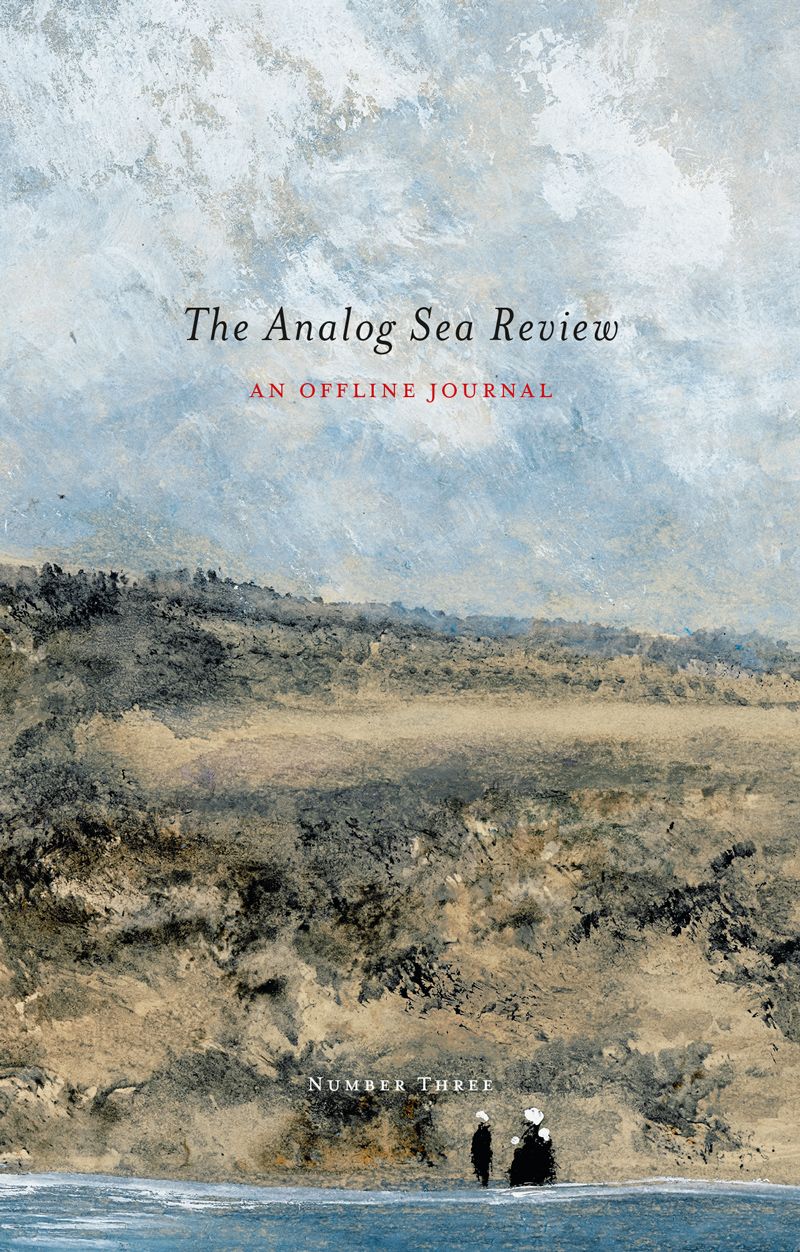
“For this man, who was so afraid of the cold, to be attracted to the cold is a paradox that only twelve Freuds could figure out,” wrote Leonard Bernstein of Glenn Gould in a piece first published in 1983 and recently reprinted in the third edition of award-winning literary journal The Analog Sea Review. Full of affection and respect for his close friend, Bernstein recollects driving round Toronto with Gould “wrapped up in all his furs and gloves and hats, with all the windows up, the heat turned on full blast, and the radio turned on to a good music station, also full blast.”
At the time, Gould was making his 1967 radio documentary about the Arctic, The Idea of North, the first part of the Solitude Trilogy and one of the contrapuntal documentaries that Bernstein describes as Gould’s “greatest creations, the realizations of his desire to move from the world of performance to that of ‘composition’.”
Bernstein’s piece kicks off a section of The Analog Sea Review that is a tribute to Glenn Gould––and a nuanced exploration of music, the Arctic, and solitude. Alongside poetry, artwork, and non-fiction, there is enlightening analysis of The Idea of North by Harold Fink, a transcribed excerpt from Gould’s radio documentary itself, and––a rare find––a transcription of a commencement address Gould delivered at the Royal Conservatory of Music at the University of Toronto in 1964, in which he speaks beautifully of an accidental convergence of Mozart’s K. 349 fugue and the noise of a vacuum cleaner which drowned out his playing––“the inner ear of the imagination,” he discovered as a result, “is very much more powerful a stimulant than is any amount of outward observation.”
That the independent publisher of the journal, Analog Sea, should find interest in Glenn Gould’s work on solitude and interiority is unsurprising. Gould’s idea of North as metaphor for––and a literal place of––isolation echoes Analog Sea’s nurture of what the editors term offline culture. “The Internet is a spectacular tool,” writes founding editor Jonathan Simons in his “Offline Manifesto,” which introduces the third issue of the journal, but he and his team “advocate for the human right to disconnect. We seek out and cultivate those for whom the roots of life remain firmly planted in the real world, unfettered by the Internet and its incessant drip of spectacle and noise.” Elsewhere, he notes that “Good art rests upon the artist’s ability to think and feel separately from the crowd, to be alone, to maintain some semblance of interiority.”
The press lovingly produces a small list of hardcover titles that celebrate the multisensual, physical reality of the offline world. It sells its editions uniquely through independent bookshops and, rather than using social media, it communicates with its subscribers through letters and a free printed biannual newsletter, The Analog Sea Bulletin.
In a recent interview in magCulture, Jonathan Simons explains, “When people ask me why we ‘make it so difficult’ for people to discover Analog Sea and procure our editions, my response is that it’s intentional. […] In the age of behemoth online retailers, the commodification of books has gone too far. This is why we try to keep the trade of our books within local shops and human hands rather than algorithms. The arts and letters don’t need to be ‘disrupted,’ as the new parlance of neoliberal greed suggests. Let’s preserve all the ‘friction’ and discomfort one finds reading long or complex works of literature and not entrust their distribution to robots which disenfranchise local creative communities.”
The Analog Sea Review, no. 3 also includes writing by May Sarton, Robert Macfarlane, Sophy Roberts, Simon-Pierre Hamelin, and C.G. Jung, among many others, as well as interviews with German filmmaker Wim Wenders and depth psychologist Wolfgang Giegerich.
The Analog Sea Bulletin printed newsletter includes a complete list of international Analog Sea stockists from which you can purchase Analog Sea editions. To receive a free copy of the Bulletin, send a letter or postcard to Analog Sea at either PO Box 11670, Austin, TX 78711, United States or Basler Strasse 115, 79115 Freiburg, Germany.
Sarah Ream is an editor with Analog Sea.