The Glenn Gould Bach Fellowship
August 21, 2020
The Glenn Gould Bach Fellowship honours one of the world’s most influential and iconic pianists. Gould was famed, of course, for both his legendary performances of Bach and for his ground-breaking engagement with film and recording technology. The Fellowship seeks to emulate and celebrate these same qualities by helping a mature, established artist to recreate the music of the Baroque for the 21st century. Using the most up-to-date technology, the Glenn Gould Bach Fellow will create over the course of the Fellowship an artistic artefact or series of artefacts that will capture their unique vision. Each two-year Fellowship will enable an outstanding musician to realise an artistic vision of stature, and in the process make a statement about the music of the Baroque that endures. For more information, see www.ggbfellowship.org
The Glenn Gould Foundation encourages applications to the Fellowship.
On Recording Goldberg at the Long Room Library, Trinity College Dublin
Peter Tuite
Founding Fellow
Glenn Gould Bach Fellowship
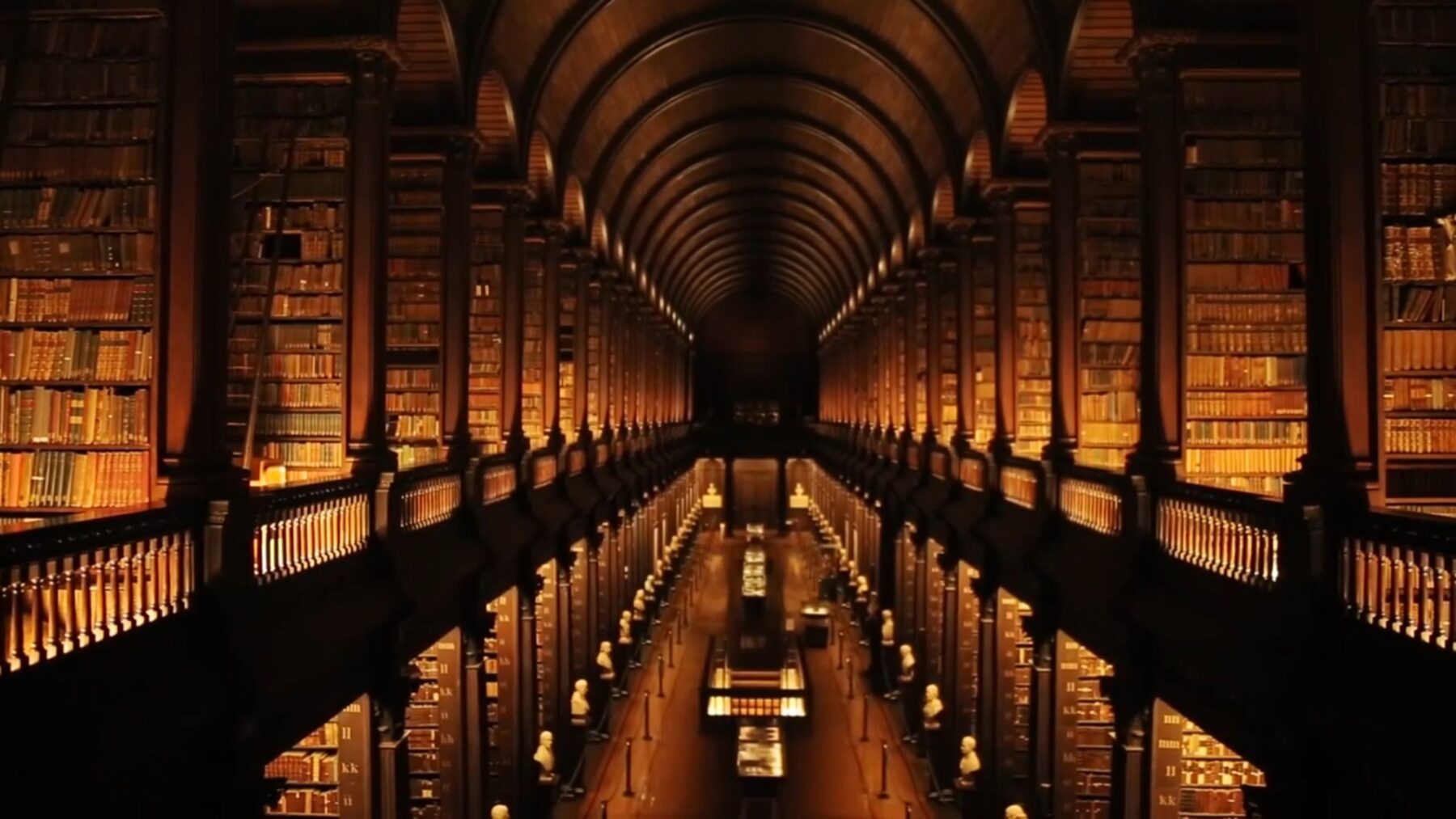
The magnificent Long Room Library of Trinity College Dublin was our setting. Completed in 1732, the same decade in which Bach began work on the Goldberg Variations, I and all the crew felt a rightness about bringing these two eighteen-century masterpieces together into one unique film. Though we’d been given special permission to film in this protected space, we’d been restricted to working at night when the library had closed its doors, after the campus had gradually emptied of tourists and students.
A Steinway D, loaned from the Royal Irish Academy of Music, had been put in place two days previously (requiring seven men to lift it up two sets of stairs), and it took a further few hours of setting up on the day before we were finally ready. I remember taking some time in one of the quiet rooms off the main space, thinking through the famous aria in my head, going over the complex eddies of its shapes and rhythms, when the engineer’s voice came over the speakers.
—Peter: ready when you are.
I ventured into the space from the opposite end and made the long walk down the magnificent centre aisle. Lining each side, the busts of various famous artists and thinkers, fronting the tall backdrop of books—it felt like reaching the centre of Borges’ Infinite Library. As I took my seat at the piano, I could see obscured in the nooks and crannies of the surrounding space various members of the film crew, all shoeless so as not to make a single sound, cameras readied on tripods, microphones strategically positioned. One of the cameramen emerged from behind me with a clapboard.
—Goldberg Variations. TCD Long Room. Take One, he said aloud.
—Take one, the disembodied engineer’s voice repeated authoritatively over the speakers.
Then a smack of sound, wood on wood, followed by an intense silence the likes of which I’d rarely experienced before, and have rarely experienced since. It wasn’t simply the expectation, the sense of pregnant arrest in the air. Rather, something more like a beautiful canvas upon which I’d been tasked to trace a most delicate, intricate calligraphy. I closed my eyes, and as is often my custom, played through the aria’s final bars in my mind’s ear. Slowly, imperceptibly, its subtle pulse revealed itself.
My breathing steadied. And as I began to sense that rhythmic centre that all musicians search for, I became aware for the first time of the solitude and stillness of the whole occasion. I was hardly alone, and yet, somehow, as everyone held their breath, in that moment of silence, I could feel that necessary aloneness that accompanies any kind of private contemplation.
The seconds deepened. “I felt that I was almost part of that country” Glenn Gould once said, “part of that peaceful surrounding, and I wished that it would never end.” He was speaking about The Idea of North – more specifically about the landscapes, spiritual and actual, of Northern Canada – as part of a ground-breaking radio documentary composed in the 1960s. And yet a similar sense struck me at that moment. I raised my hands to the keys. And when the first sounds of the aria rose to the heights of the barrel-vaulted ceiling, I too wished this peace and solitude would never end.

Praised for his “astonishing technical facility,” “singing line,” and “perfect sense of balance,” Peter Tuite has garnered international acclaim for his recital and concerto appearances throughout the world. Educated at Trinity College Dublin, the University of Oxford, and as a Fulbright Scholar at the Peabody Institute of the Johns Hopkins University, he subsequently went on to become Head of the Keyboard Faculty of the Royal Irish Academy of Music. Between 2015 and 2018, he served as the Head of Piano and Keyboard Instruments at Trinity Laban Conservatoire of Music and Dance in London—and as of 2020 continues to serve on the faculty of both these institutions. As the Founding Fellow of the Glenn Gould Bach Fellowship awarded by the City of Weimar, his project will involve exploring differing perspectives on the late keyboard works of J.S. Bach.
Founding Fellow Peter Tuite talking about the Fellowship, and playing the first and second variations of Goldberg.