Verne Edquist (1931-2020) – Glenn Gould’s Piano Man
September 3, 2020
An Appreciation by Katie Hafner
Verne Edquist, a master piano tuner who spent most of his professional life working for one client – Glenn Gould – died peacefully on August 27 after a long illness. He was 89.
I first met Verne in the summer of 2004, when I traveled to Toronto to start research for a book about Gould’s beloved CD-318. Verne and his wife, Lillian, welcomed me into their house on the outskirts of town and we sat for several hours in their living room, my recording device whirring away, while Verne recounted his life, and his work with the very eccentric Glenn Gould.
It was the start of an acquaintanceship that endured well past the publication of my book, A Romance on Three Legs: Glenn Gould’s Obsessive Quest for the Perfect Piano
During that first meeting, I heard about the late-night recording sessions. Verne always arrived early to start tuning. Even after he finished tuning, he was required to stay throughout the session, in the event that a note should slip out of tune. I also heard about Gould’s endearingly bizarre coffee orders, his despair over the damaged CD-318, and his desperate calls to Verne late in his life, while re-recording The Goldberg Variations on a Yamaha.
Charles Verne Edquist was born in 1931, a year before Gould, in a little village in Saskatchewan called Glen Mary, 400 miles north of the Montana border. When Verne was born, the province was already reeling from crop failures, and poverty was the mainstay of his early childhood. His father, a Swedish immigrant with a penchant for troublemaking, was deported back to Sweden when Verne was a toddler. His mother, Thea, who, like Verne’s father, had come to Canada in 1905 as part of a stream of Swedish immigrants, was left to raise the children on her own. When Verne was two, the family moved into an abandoned farm house. A baby sister died at the age of 11 months, an event that precipitated a series of moves. Thea took work as a live-in housekeeper in order to have a place for her family.
Verne became a piano tuner because of a physical limitation: near blindness. When Verne was six, his uncle Hjalmar noticed that the boy was having trouble seeing. A doctor diagnosed congenital cataracts.
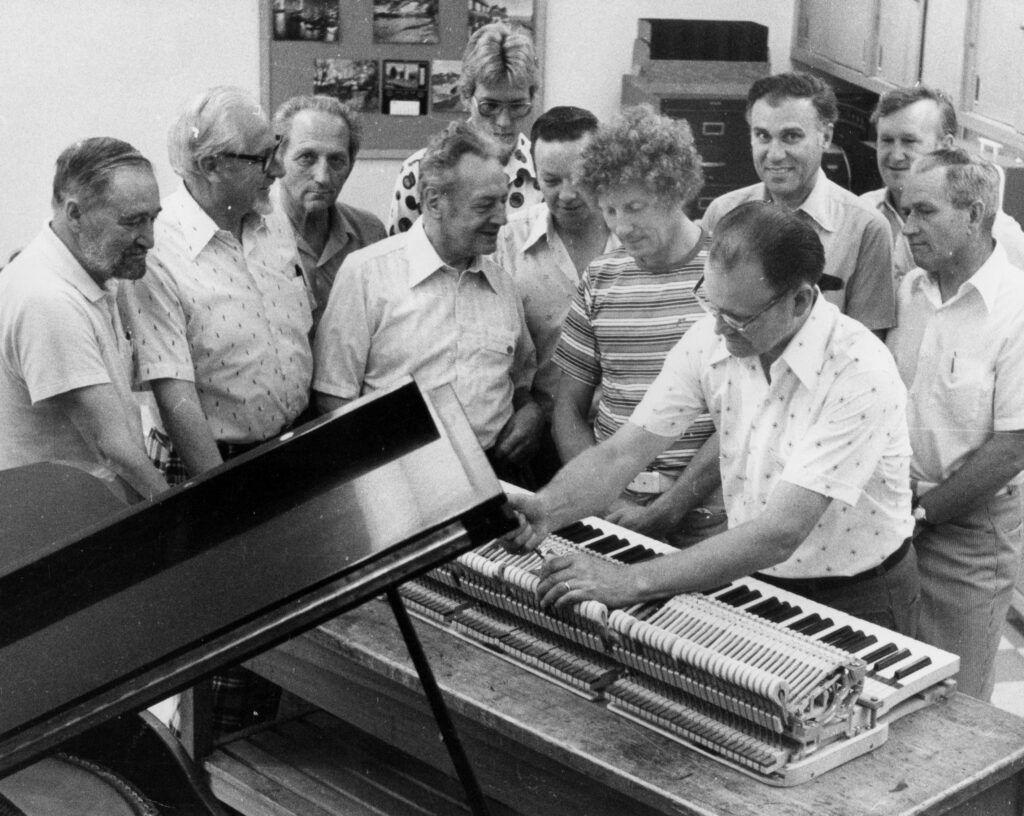
In the winter of 1938, deep into the Depression, eight-year-old Verne was put on a train and sent 2,000 miles east, to the Ontario School for the Blind. It was when Verne was in the school’s hospital for six weeks with scarlet fever that he first heard the sound of a piano being tuned – the intervals being stretched and shortened. It was a pinging sound, not quite musical, and hardly melodic.
Once he had recovered,Verne sought out the school’s tuning shop. As it happened, he had a near perfect ear, and he studied the craft of piano tuning with rigor and determination.
Years later, Verne often took to quoting his tuning teacher, J. D. Ansell, whose favorite aphorism was “The only place where success comes before work is in the dictionary.” To give Verne experience, Ansell started taking his young protégé into town to tune pianos in private homes. Verne was allowed to keep the money – $2.50 per piano, and sometimes, when he got lucky, $3.00 – which he put toward some basic tools: a tuning wrench, a tuning fork, needle-nose pliers, gauges for measuring the diameter of piano wire, and rubber wedges for muting strings.
After graduating from high school at age 19, Verne knew his best chance at a job was to find work as a chipper in one of the many piano factories in Toronto (in the early 20th century the city directory listed no fewer than sixteen piano manufacturers). The chippers were the first tuners to work on a newly strung piano, so incomplete in construction that it still had no keys. Those initial tunings are done, first with a pitch fork, then by ear, by plucking the strings with a small chip of wood.
Verne started out as an apprentice chipper in the factory of the Winter Company, one of piano manufacturers.
He had a fishing tackle box that he had converted to a tuner’s toolbox. Over the years Verne collected dozens of tools. Some he bought from old-timers, and others he adapted from other trades. He had surgical forceps and dental explorers, which made dandy hooks, opticians’ screwdrivers for adjusting harpsichords, barber scissors for trimming felt, and shoemaker pegs for plugging holes. From the welding trade he took soapstone, a dry lubricant for the buckskin that can squeak in the action of older pianos.
After being laid off, Verne decided to go door-to-door, tuning pianos. He was systematic, choosing a sequence of different neighborhoods around Toronto that he could reach by street car. Verne soon grew bolder and began cold-calling at sergeants’ messes, asylums, and prisons. He would walk a mile and a half in a snowstorm to tune a piano, and charge $3 for a tuning. He was lucky to get one tuning a day. “That’s how things were,” he recalled years later. “I was glad to get the work. During that time you did what you could.”
In 1952, at the age of 21, Verne was hired as a fine-tuner in the Heintzman factory, then the largest piano manufacturer in Canada. Verne’s tuning always stood out, even when he was tuning pianos for the first time. To trained ears, the quality of Verne’s tuning was always superior.
In 1961, he moved to the T. Eaton Co., to take over as the concert tuner. Verne liked to think he could take a piano beyond mere sound, into realms of color. And he liked to think he was giving people a glimpse of that color every time he tuned a piano. Muriel Mussen, who ran the concert department, sat in a small office off the showroom floor, and came to recognize Verne’s spare style of tuning whenever she heard it. Unlike many tuners, who banged a key as hard as they could, he kept it gentle, careful not to hit the key any harder than he had to. Halfway into a piano, Verne would often hear Miss Mussen call out, “I know it’s you tuning out there, Verne.”
One afternoon about a year after Verne started at Eaton’s, Miss Mussen sent him across town to Glenn Gould’s apartment to tune Gould’s old Chickering. All Gould wanted, he told Verne, was for the tuner to do what had been done hundreds of times before: get the piano into playable condition, if only for the time being. But Verne refused, telling Gould that the tuning pins were so loose they needed to be replaced.
Verne’s stubborn insistence on doing things his way had endeared him to Gould, and the encounter galvanized what was to become a decades-long association between a pianist and his technician.
Verne tuned for many famous musicians over the years, including Duke Ellington, Arthur Rubinstein, Rudolf Serkin, Victor Borge, and Liberace. But it was the business he got from Gould that eventually enabled him to quit Eaton’s employ and sustain his family for two decades.
Each tolerated the other’s idiosyncracies, which were in ample evidence in both men. Gould’s quirks, of course, were legion and legendary. One of their earliest conversations was about Verne’s physical limitations. “I can’t see very well, but I get the job done,” Verne told Gould. And Gould replied that of this he had no doubt. Nothing further on the topic was ever said.
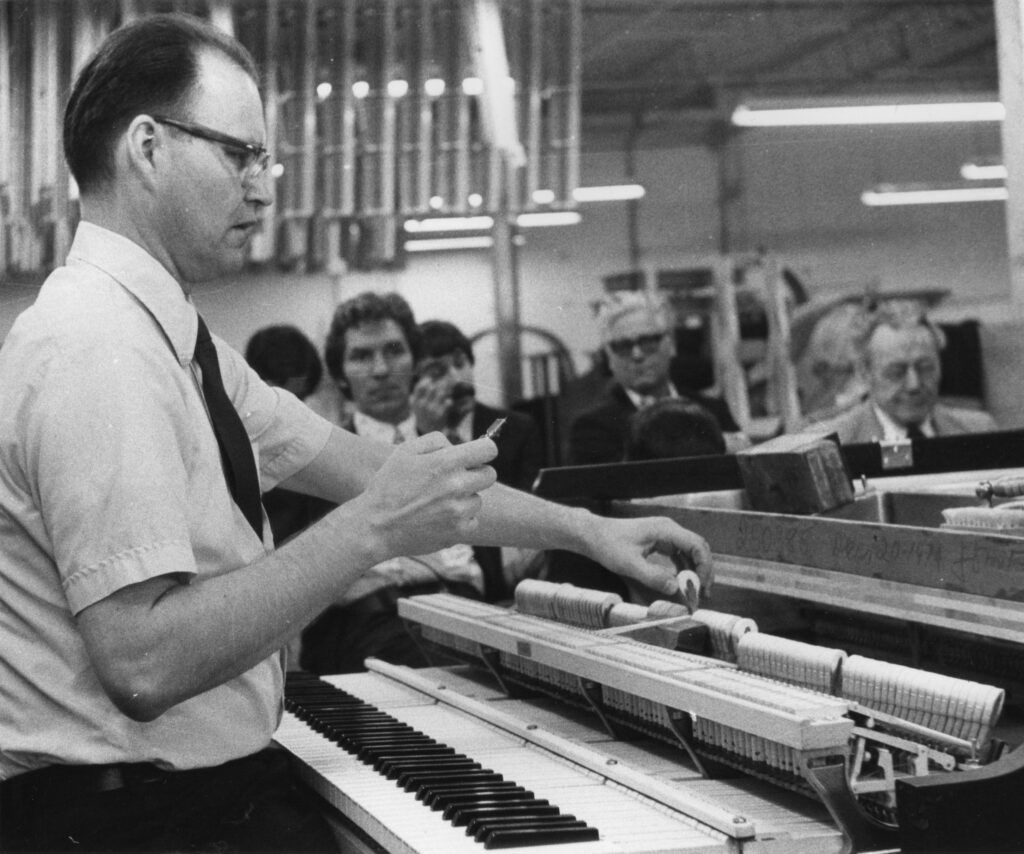
Like parents attuned to the slightest mood shift in their infant, Gould and Verne paid close attention to any changes in the piano’s tone during a session. The two men grew slightly competitive about being the first to hear when the piano was going out of tune. Verne took special pride in his quick auditory reflex. He could tell when a tone was starting to curl a little bit, and invariably it was Verne who caught it first. But he often said nothing until, a minute or so later, Gould heard it too, stopped in the middle of a take and asked Verne to fix it.
Well into his career, if listening to a piano recording, Verne knew if the tuning was his. Also, while learning to tune, Verne had discovered he had excellent, nearly perfect pitch, that rare psycho-acoustical ability to remember the pitch of every note, to know what a C sounds like the way most people know what the color blue looked like.
All his life, Verne heard music through his own particular synaesthesia – in colors. If you asked him how he knew that an F was an F, he would say, “oh that’s blue.” C was a slightly lime green. The key of D was a sandy hue, E was yellowy-pink, A was white, G orange and B dark green. For years he was ashamed of this rather oddball talent. When he finally told Glenn Gould about it, his boss reacted as if it were the most natural thing in the world.
After Gould’s beloved Steinway, CD-318, was damaged beyond repair, Gould decided in 1981 to record The Goldberg Variations on a Yamaha. When Verne heard this, he was dumbfounded. Throughout his career he had chronically disapproved of Yamahas. Yamaha used machines where Steinway used hand-operated tools, he thought; the speed with which Yamaha managed to produce its pianos made him suspicious.
When I interviewed Verne for my book, I was struck by what a kind and gentle man he was. It came as a surprise to hear him voice some reservations, even a little bitterness, about his most famous client. Although Gould had often gone out of his way to accommodate Verne’s schedule and never uttered an unkind word to him, nor did he, in the two decades they worked together, gone out of his way to praise Verne’s tuning. To have gone so many years without hearing so much as a “nice job” had clearly taken its toll.
I traveled to Toronto a handful of times to research the book, yet called Verne continually over three years. He was always happy to hear from me, and always willing to stay on the phone for as long as I needed. Once, when material was over my head, I enlisted the help of John Callahan, a technician and highly respected restorer of Steinways, to translate Verne’s technical jargon into something I might understand. We put the phone on speaker and I madly took notes while John and Verne talked. A few weeks later, I called Verne from my car, and as I was backing up, he heard the Prius’s backup tone and said, in his inimitably cheerful way, “Why, that’s an F sharp!”
The last time I saw Verne was in 2012, when he and I were invited to Hong Kong to address the Chopin Society’s Joy of Music Festival. Verne was accompanied by his son, and we all stayed at the Hong Kong YMCA, which had a splendid view of the Symphony of Lights over Victoria Harbour. Verne loved it.
Verne is survived by Lillian, his dear wife of over 60 years, his daughter Marilyn, and sons Carl, Eric, and Graham.
Interview with Verne Edquist at his home, September 2017, taped for The Glenn Gould Gathering, Tokyo, curated by Ryuichi Sakamoto. Video courtesy of Zakkubalan.

Katie Hafner is a journalist and author. She has published six books, including A Romance on Three Legs: Glenn Gould’s Obsessive Quest for the Perfect Piano, which Kirkus Review called “the musical version of ‘Seabiscuit.’ ” Hafner is also host and executive producer of the podcast Our Mother Ourselves, a weekly conversation with one offspring of one extraordinary mother.
Find Katie Hafner elsewhere online: Twitter | Official Website | The New York Times