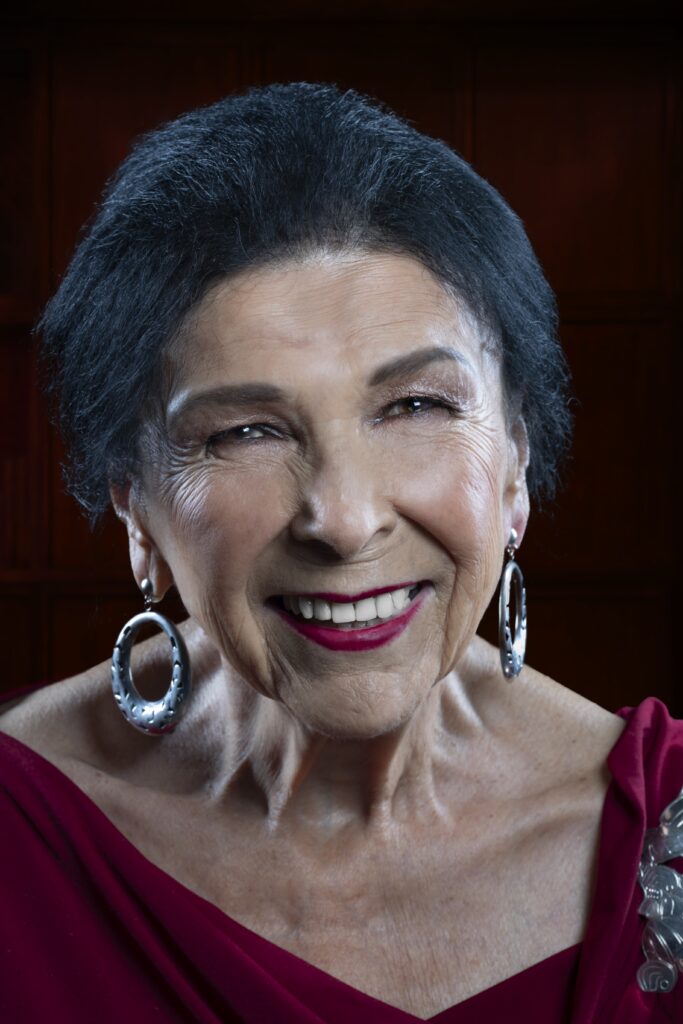
Announcing the 13th Laureate of The Glenn Gould Prize: Alanis Obomsawin
October 15, 2020

Through her multifarious artistic work and public activism, Obomsawin has been one of Canada’s most passionate and visible advocates for Indigenous peoples. She is a highly distinguished documentary filmmaker, and her prolific, internationally acclaimed output for the National Film Board, spanning almost fifty years, has addressed a huge range of themes and issues relating to Canada’s Indigenous peoples. She has also had long careers as a singer-songwriter and visual artist devoted to telling Indigenous stories.
Life and Career
A member of the Abenaki Nation, Obomsawin was born near Lebanon, New Hampshire, though her family returned to the Odanak reserve, near Sorel, Quebec, when she was six months old. There she learned Abenaki history, legends, and songs, and she would remember her time on the reserve as idyllic. When she was nine, her family moved to Trois-Rivières. The transition was difficult, Obomsawin’s father died three years later, and she rebelled against the bullying and eurocentrism she encountered in school, which helped inspired her to become an artist who tells aboriginal stories. She left Trois-Rivières at age 22, spent two years learning English in Florida, then, in the late 1950s, settled in Montreal, where she still lives.
In 1960, Obomsawin made her debut as a singer in New York. She went on to perform at venues including reserves, schools, prisons, museums, festivals, and on television. In concert she sang traditional aboriginal songs and other repertoire to her own accompaniment on hand-drum or rattle, and told stories in several languages. Her 1988 album Bush Lady, comprising traditional Abenaki songs and original compositions, offers an introduction to her musical style. Even as her filmmaking career took off, she continued to sing around North America and Europe. She coordinated aboriginal programming for the Mariposa Folk Festival (1970-76), and appeared for several years in the 1970s on the Canadian version of Sesame Street. She retired from concerts in the mid-1980s, though made an acclaimed comeback in 2017, at age 85, singing Bush Lady in its entirety at a festival in The Netherlands.
“When the last tree is cut, the last fish is caught, and the last river is polluted; when to breathe the air is sickening, you will realize, too late, that wealth is not in bank accounts and that you can’t eat money.”
– Alanis Obomsawin
By 1966, Obomsawin was already well-enough known as an activist to warrant a profile in the CBC television series Telescope, on the basis of which she was hired by the National Film Board (NFB) to be a consultant on projects relating to aboriginal peoples. In 1971, she directed her first film, Christmas at Moose Factory, and in 1977 she became a permanent NFB staff member and made her first feature-length film, Mother of Many Children, about the central place of women and mothers within indigenous cultures. To date she has directed more than fifty films (mostly documentaries) for the NFB, usually serving as producer and writer, too, and she has earned national and international recognition. Her filmmaking uniquely pairs indigenous oral traditions with the techniques of documentary cinema.
Obomsawin’s films have addressed a huge range of topics including indigenous artists (Amisk, 1977), fishing rights (Incident at Restigouche, 1984; Is the Crown at War with Us?, 2002), the struggles of young aboriginal people (Richard Cardinal, 1986; Poundmaker’s Lodge, 1987), homeless aboriginal people in Montreal (No Address, 1988), the rights of indigenous peoples to manage natural resources on ancestral land (Our Nationhood, 2003), and her own “horrible experience” of public school (When All the Leaves are Gone, 2010). She made a series of films about the Mohawk-government standoff at Oka in 1990, including Kanehsatake: 270 Years of Resistance (1993), her best-known work. She has made two films about the people of Odanak (Waban-Aki, 2006; Gene Boy Came Home, 2007), and has told the stories of individuals (My Name Is Kahentiiosta, 1995; Spudwrench, 1997; Professor Norman Cornett, 2009). She also directed two films for the NFB’s Canada Vignettes series:The Wild Rice Harvest, Kenora (1979) and June in Povungnituk (1980).
“So much history can be lost if no one tells the story—so that’s what I do. I tell the stories.
This is my way of fighting for social change.”
– Alanis Obomsawin
Obomsawin has continued to make films into her eighties, including The People of the Kattawapiskak River (2012), about the housing crisis on the Attawapiskat nation in northern Ontario; Hi-Ho Mistahey! (2013), about an Indigenous-education initiative; Trick or Treaty? (2014), about the struggles of Indigenous leaders negotiating with the federal government; We Can’t Make the Same Mistake Twice (2016), about a human-rights complaint alleging federal-government discrimination against Indigenous children; Our People Will Be Healed (2017), about a Cree education centre in Manitoba; and, most recently, Jordan River Anderson, The Messenger (2019), about the struggle to provide indigenous children with the same services available to other Canadians.
Obomsawin is also a prolific visual artist, known especially for engravings and prints, which she has exhibited internationally, including in retrospectives at the Museum of Modern Art in New York (2008) and the Montreal Museum of Fine Arts (2019). Images of mothers and children are prominent in this work, which also draws on animal spirits, historical events, and her own dreams.
Obomsawin has served on the boards of many organizations, some devoted to film and broadcasting, including the NFB, the Aboriginal Peoples Television Network, and PBS, others including the Canada Council and the Native Women’s Shelter of Montreal.